

How it works
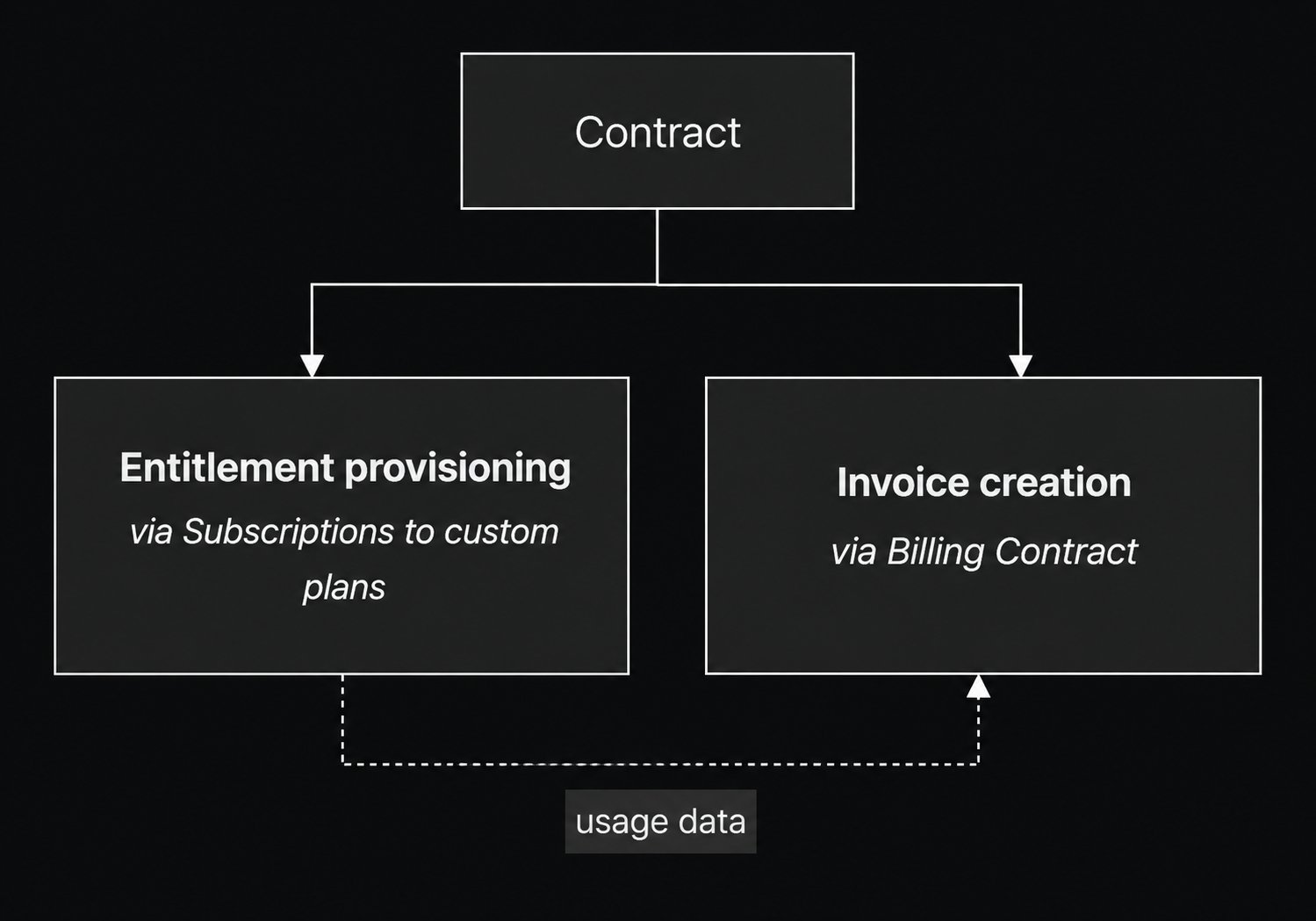
A contract represents a signed order form: the sales agreement, whether a PDF or a Salesforce opportunity, that defines what the customer bought. Creating a contract in Stigg attaches that order form and brings together two things that are normally managed separately:- Entitlement provisioning: achieved by creating subscriptions to custom plans, so what a customer signs is what Stigg enforces.
- Invoice generation: achieved by setting up a billing contract, which defines the payment terms, billing schedule, and line items used to generate invoices.
Benefits
Contract Management gives enterprise invoicing the same flexibility teams otherwise get from spreadsheets and custom scripts, without leaving Stigg or reconciling data by hand.- Maximum flexibility for enterprise invoicing supports:
- Any line item
- Any pricing model
- Any billing period
- Any billing cadence (in advance or in arrears)
- Any payment terms
- Consolidate line items into one invoice, or bill any of them on a separate invoice, per your choice
- Invoice anchors (set which date a separate invoice’s billing cycle starts from)
- Native integration with Stigg’s product catalog: contract line items can be mapped directly to the plans, add-ons, and features already modeled in your product catalog.
- Native integration with Stigg’s metering infrastructure: bill usage-based enterprise contracts instantly, using the same usage that’s reported to Stigg.
- Works alongside your existing billing stack: Contract Management orchestrates entitlement provisioning and invoicing on top of tools like Stripe Billing and NetSuite. It doesn’t replace them, and your existing product-led motions are unaffected.
- End-to-end AI monetization: Stigg is the only solution that provides a single experience for both enterprise entitlement provisioning and invoicing, so the two never drift apart.
Availability
Contract Management is currently in beta.